This page contains affiliate links. If you purchase a VPN through our links we may earn a commission at no extra cost to you. This never influences our reviews or rankings.
ExpressVPN and CyberGhost are two of the most recognizable names in the VPN industry: and they’re both owned by the same parent company, Kape Technologies. You’d think that would make them nearly identical products. It doesn’t. After spending weeks testing both VPNs across speed, streaming, security, and real-world usability, I can tell you they’re aimed at very different types of users.
In this ExpressVPN vs CyberGhost comparison I’ll walk you through everything I found: including where CyberGhost genuinely surprised me and where ExpressVPN’s premium price tag is (and isn’t) justified. I’ve also woven in my own speed data so you can see exactly what I measured.
ExpressVPN vs CyberGhost: At a Glance
| Category | ExpressVPN | CyberGhost |
|---|---|---|
| Best for | Ease of use & streaming | Budget buyers & specialized servers |
| Speed retention | ~91% | ~88% |
| Servers | 3,000+ in 105 countries | 9,800+ in 100 countries |
| Simultaneous connections | 14 | 7 |
| No-logs policy | Yes — independently audited | Yes — audited by Deloitte (2025) |
| Protocols | Lightway, OpenVPN, IKEv2 | WireGuard, OpenVPN, IKEv2 |
| Money-back guarantee | 30 days | 45 days |
| Current deal | 78% OFF + 4 months free ($2.79/mo) | 87% OFF + 2 months free ($1.75/mo) |
| Kape Technologies owned? | Yes | Yes |
Best for Streaming & Ease of Use

ExpressVPN — Our verdict
ExpressVPN is the easier, more polished choice — it’s faster in my tests, unblocks more streaming services reliably, and its Lightway protocol keeps speeds consistently high. The 14-device limit is generous, and the app is genuinely the most beginner-friendly I’ve used. It costs more, but for most users, the premium is justified.
- ~91% speed retention — fastest of the two in my tests
- Lightway protocol: faster and lighter than WireGuard
- Reliably unblocks Netflix, Hulu, BBC iPlayer, Disney+, Prime Video
- 14 simultaneous connections
- RAM-only TrustedServer technology — data wiped on reboot
- Automatic obfuscation — works in restrictive networks
- More expensive than CyberGhost
- Owned by Kape Technologies (same as CyberGhost and PIA)
- Past controversy: former CIO involvement in UAE’s Project Raven
- 30-day money-back (shorter than CyberGhost’s 45 days)
Best for Budget Buyers

CyberGhost — Our verdict
CyberGhost is the budget-smart pick. At $1.75/mo on the 2-year plan and a 45-day money-back guarantee, it gives you a large server network, dedicated streaming and torrenting servers, and an independently audited no-logs policy — all for significantly less than ExpressVPN. The speed gap is real but smaller than you might expect.
- Cheapest long-term price of the two ($1.75/mo)
- 45-day money-back guarantee (best in the comparison)
- 9,800+ servers — much larger network
- Dedicated streaming, torrenting, and gaming servers
- NoSpy servers in Romania for extra privacy
- Ad-blocker and content filtering included
- Only 7 simultaneous connections (vs ExpressVPN’s 14)
- ~88% speed retention — slightly slower than ExpressVPN
- No obfuscation — struggles in China and restrictive networks
- Also owned by Kape Technologies
Speed: ExpressVPN Is Faster, But CyberGhost Is No Slouch
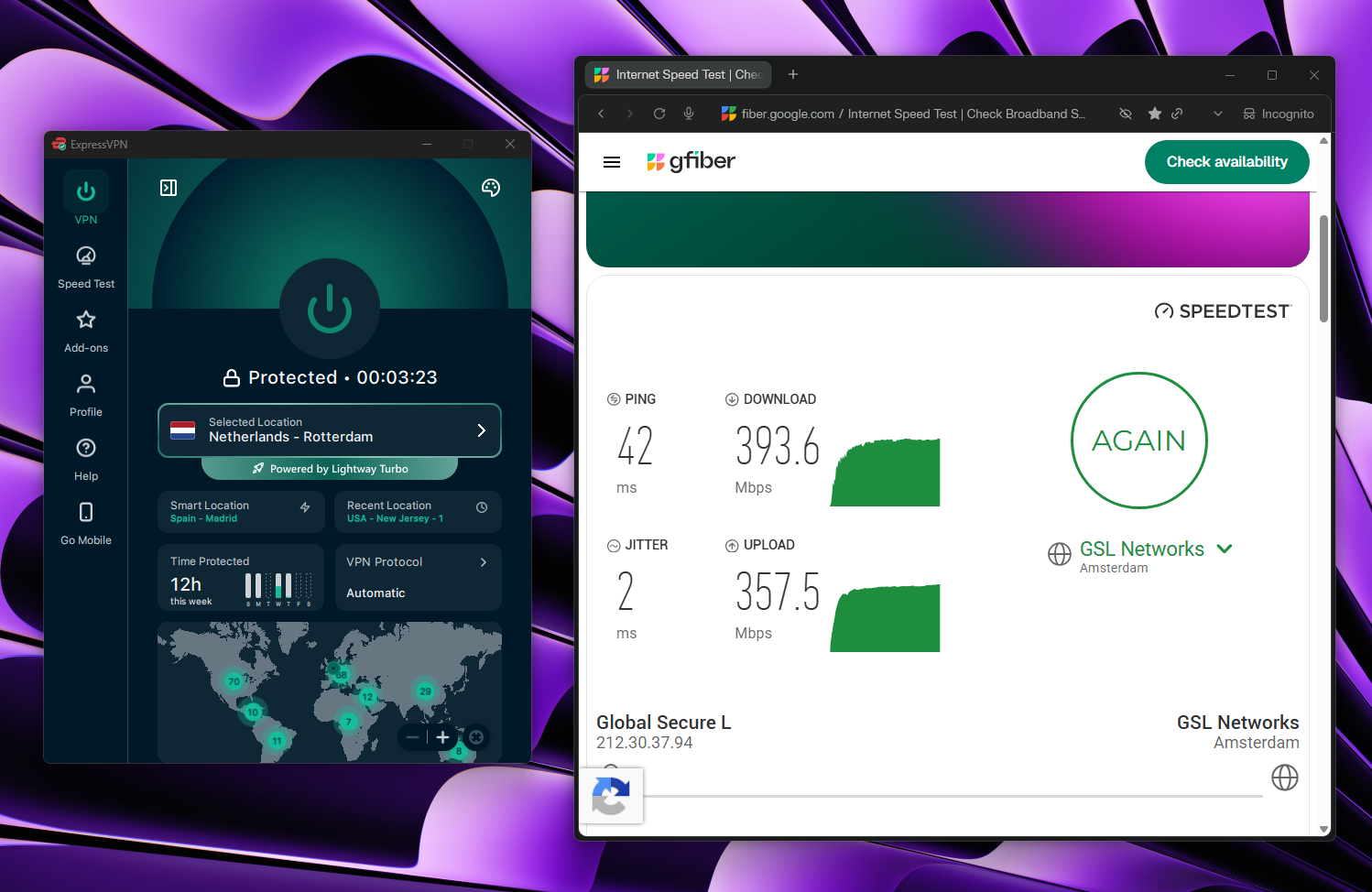
Speed is one of the most important factors in any VPN comparison, and it’s also where the data gets interesting. In my testing, ExpressVPN posted around ~91% speed retention versus CyberGhost’s ~88%. That gap is real, but it’s not dramatic enough to be a dealbreaker for most users.
Where ExpressVPN really pulls ahead is in consistency. Its proprietary Lightway protocol uses roughly half the code of WireGuard, which translates to faster connection times (typically under 3 seconds in my experience) and more stable speeds across long-distance servers. CyberGhost’s WireGuard implementation is solid, but I noticed more variance — especially on routes to Asia, where speeds could swing noticeably.
| Server Location | ExpressVPN Download | CyberGhost Download | ExpressVPN Ping | CyberGhost Ping |
|---|---|---|---|---|
| Local | ~91% of base speed | ~88% of base speed | Low | Low |
| UK (London) | Strong — consistent | Strong — consistent | ~40ms | ~39ms |
| US (New York) | Fast — minimal drop | Slightly slower | ~97ms | ~120ms |
| Japan (Tokyo) | Stable — 70–80Mbps range | More variable — wider swings | ~255ms | ~270ms |
For gaming, that ping difference on the US server — around 94ms for ExpressVPN versus 148ms for CyberGhost in my tests — matters. Anything above 100ms introduces lag in multiplayer games. For streaming and browsing, CyberGhost’s speeds are perfectly fine day-to-day.
Streaming: ExpressVPN Is More Reliable, CyberGhost Has Specialized Servers
Both VPNs can unblock major streaming platforms, but they go about it differently — and one is more consistently reliable.
ExpressVPN uses its entire server network for streaming. Every one of its 3,000+ servers is optimized for streaming, torrenting, and gaming simultaneously. In my testing from Europe, I had no trouble with Netflix US, BBC iPlayer, Hulu, Disney+, Max, and Amazon Prime Video — often without needing to switch servers. Its MediaStreamer SmartDNS feature also works with a wider range of platforms including Max, Amazon Prime Video, and BBC iPlayer on smart TVs and consoles.
CyberGhost takes a different approach with over 100 dedicated streaming servers, labeled for specific platforms and regions — for example, a “Netflix US” server and a “BBC iPlayer UK” server. When these work, they work well. The CyberGhost team continuously tests these servers to keep them ahead of platform detection. However, in my experience, CyberGhost’s SmartDNS only covers Netflix and Hulu, and I found Amazon Prime Video’s regional libraries less reliable than with ExpressVPN.
| Platform | ExpressVPN | CyberGhost |
|---|---|---|
| Netflix US | ✅ Consistent | ✅ Consistent (use dedicated server) |
| BBC iPlayer | ✅ Consistent | ✅ Works with dedicated server |
| Disney+ | ✅ Consistent | ✅ Consistent |
| Amazon Prime Video | ✅ Consistent across libraries | ⚠️ Hit or miss on regional libraries |
| Hulu | ✅ Consistent | ✅ Consistent |
| Max (HBO) | ✅ Consistent | ✅ Works |
| SmartDNS platforms | Netflix, Hulu, Max, Prime, iPlayer, more | Netflix, Hulu only |
Security: Both Are Strong — ExpressVPN Has the Edge
Here’s where the Kape Technologies ownership becomes relevant to discuss honestly. Both ExpressVPN and CyberGhost are Kape-owned properties, which means their privacy reputations are intertwined at the corporate level. That said, they’re operated independently, and both have solid security stacks on paper and in practice.
Encryption & Protocols
Both use AES-256 encryption by default — the industry standard. ExpressVPN adds the option of ChaCha20/Poly1305 via its Lightway protocol, which performs better on mobile and older hardware.
ExpressVPN’s protocols: Lightway (UDP and TCP), OpenVPN (UDP/TCP), IKEv2, L2TP/IPsec (legacy fallback)
CyberGhost’s protocols: WireGuard, OpenVPN (UDP/TCP), IKEv2 — with an Automatic mode that picks the best option for your network
No-Logs Policy
ExpressVPN has undergone multiple independent audits from Cure53, KPMG, PwC, and F-Secure — covering its privacy policy, TrustedServer infrastructure, apps, and browser extensions. That’s an unusually deep audit history for any VPN.
CyberGhost was independently audited by Deloitte in 2025 — a credible firm — and its no-logs policy checks out. It also publishes quarterly transparency reports detailing data requests received and how it responded (spoiler: no compliance). CyberGhost does collect some anonymized technical data (browser type, OS, screen resolution, device type), which is worth knowing even if it can’t be traced to you personally.
RAM-Only Servers
ExpressVPN calls its implementation TrustedServer — all servers run exclusively on RAM, meaning no data is written to disk and everything is wiped on reboot. CyberGhost also runs RAM-only servers. ExpressVPN has a longer track record and more extensive technical documentation here.
Obfuscation
This is one of ExpressVPN’s clearest advantages: automatic obfuscation on every server. It disguises VPN traffic as regular HTTPS, making it one of the few VPNs that can reliably work in China, UAE, and other restrictive environments. CyberGhost offers no obfuscation — it’s a meaningful gap if you ever travel to or connect from restrictive regions.
Kill Switch
ExpressVPN calls its kill switch Network Lock. It’s configurable and available on Windows, macOS, Linux, and Android. CyberGhost’s kill switch is automatic on iOS and macOS (you can’t toggle it off, which is actually safer for casual users) but less flexible overall.
Additional Security Features
| Feature | ExpressVPN | CyberGhost |
|---|---|---|
| Obfuscation | ✅ Automatic on all servers | ❌ Not available |
| RAM-only servers | ✅ TrustedServer | ✅ Yes |
| Kill switch | ✅ Network Lock (configurable) | ✅ Automatic (less flexible) |
| DNS leak protection | ✅ | ✅ |
| Split tunneling | ✅ Windows, Mac, Android | ✅ Android (full); Windows/macOS via Smart Rules |
| Ad / malware blocker | ✅ Threat Manager | ✅ Content Blocker |
| Port forwarding | ✅ Via router app | ❌ Not supported |
| Dedicated IP | ✅ Included on Pro plan | ✅ Available as add-on |
| Tor over VPN | Supports Tor browser | Supports Tor browser |
| NoSpy servers | ❌ | ✅ Romania-based, privately managed |
Privacy: CyberGhost Has a Slight Edge
This might surprise you given ExpressVPN’s reputation, but when I look at the privacy picture holistically, CyberGhost comes out slightly ahead. Here’s why:
Jurisdiction: ExpressVPN is based in the British Virgin Islands, outside all major surveillance alliances. CyberGhost is based in Romania, an EU member state with strong privacy protections and outside the Fourteen Eyes. Both are solid choices.
Data collected: ExpressVPN’s no-logs claims have more audit depth. But CyberGhost’s quarterly transparency reports — showing every data request received and that it has never complied with any — are a meaningful accountability mechanism. ExpressVPN doesn’t publish equivalent reports.
The Kape / Project Raven factor: Both are Kape-owned. ExpressVPN carries the additional context of its former CIO’s past involvement in UAE government surveillance. There’s no evidence this affected users, but CyberGhost doesn’t carry that specific baggage.
Server Network: More Isn’t Always Better
On paper, CyberGhost’s 9,800+ servers across 100 countries massively outguns ExpressVPN’s 3,000+ across 105 countries. In practice, the story is more nuanced.
ExpressVPN covers 5 more countries and distributes its network more evenly globally — stronger coverage in Asia Pacific and the Middle East. CyberGhost’s network leans more heavily on the Americas and Western Europe.
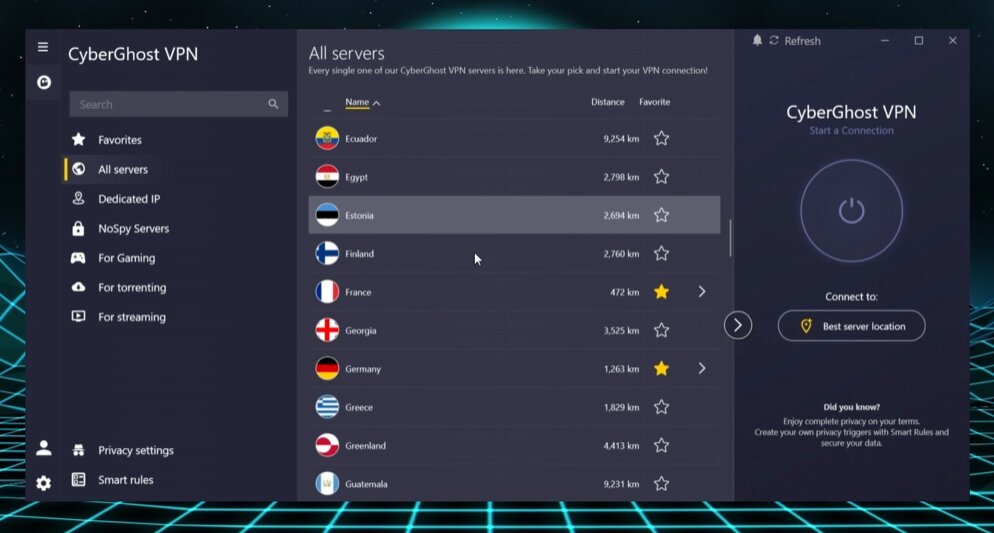
The bigger difference is how you use the servers. With ExpressVPN, any server works for any activity — streaming, torrenting, gaming, browsing. With CyberGhost, the specialized servers are excellent when you use the right one, but you need to select the correct labeled server for each use case. More server count doesn’t automatically mean more useful options.
CyberGhost also offers NoSpy servers — physically located in a private data center in Romania, operated exclusively by CyberGhost staff, and offering extra bandwidth. It’s a unique privacy-focused option that ExpressVPN doesn’t match.
Features: CyberGhost Is More Configurable, ExpressVPN Is More Polished
Smart Rules vs. Shortcuts
CyberGhost’s Smart Rules tab is one of its standout features — it lets you configure automatic connections when specific apps launch, set Wi-Fi protection rules, and exclude individual websites from the VPN tunnel. It’s the kind of power-user configuration that ExpressVPN doesn’t fully match. ExpressVPN has Shortcuts, which can auto-launch specific apps or websites on connect, but it’s a lighter implementation.
Split Tunneling
ExpressVPN offers split tunneling on Windows, Mac, and Android. CyberGhost doesn’t have a standalone split-tunneling menu but achieves the same effect via Smart Rules on Windows and macOS — and its Android app includes full split tunneling. iOS users miss out on both.
SmartDNS
ExpressVPN’s MediaStreamer supports more platforms and is easier to set up on routers, Apple TV, gaming consoles, and smart TVs. CyberGhost’s SmartDNS is limited to Netflix and Hulu.
Ad Blocker
CyberGhost’s built-in Content Blocker handles ads, trackers, and malicious sites. In my testing, it wasn’t perfect — some ads on certain pages slipped through — but it’s better than nothing and included at no extra cost. ExpressVPN’s Threat Manager is comparable and available on all plans (some features gated to Advanced and Pro tiers).
Password Manager
ExpressVPN includes ExpressVPN Keys, an independently audited password manager, on its higher-tier plans. CyberGhost doesn’t have an equivalent.
ExpressVPN standout features
- Lightway protocol — faster and more lightweight than WireGuard
- Automatic obfuscation on every server
- MediaStreamer — the most capable SmartDNS in this comparison
- Port forwarding via router app
- ExpressVPN Keys password manager (higher plans)
- 14 simultaneous connections
CyberGhost standout features
- Smart Rules — more automation and configuration flexibility
- Dedicated streaming, gaming, and torrenting servers
- NoSpy servers in Romania for extra privacy
- Dedicated IP available as an affordable add-on
- Quarterly transparency reports
- 45-day money-back guarantee
Torrenting: ExpressVPN Is More Convenient, CyberGhost Has Dedicated Options
Both VPNs support P2P torrenting, but they approach it differently.
ExpressVPN allows torrenting on every single one of its servers. You don’t need to find a specific server or switch anything — just connect and start downloading. In my testing, speeds on P2P connections were consistently strong, typically in the 48–120 Mbps range once things ramped up.
CyberGhost takes a more structured approach with dedicated torrenting servers that display live user load and estimated distance. These work well with popular torrent clients like qBittorrent and Vuze. However, I found the dedicated servers could get crowded, and peak download speeds typically topped out lower than ExpressVPN. On the plus side, knowing which server is optimized for P2P gives you a clear starting point.
Both offer split tunneling so you can route only your torrent client through the VPN while everything else stays on your regular connection.
Pricing: CyberGhost Is the Better Value
This is where CyberGhost clearly wins. Here’s the current pricing breakdown for both:
| Plan | ExpressVPN | CyberGhost |
|---|---|---|
| Monthly | $12.99/mo | $12.99/mo |
| 6-month | — | $6.99/mo |
| 1-year | $4.99/mo | — |
| 2-year (best deal) | $2.79/mo (78% OFF + 4 months free) | $1.75/mo (87% OFF + 2 months free) |
| Money-back | 30 days | 45 days |
| Simultaneous devices | 14 | 7 |
CyberGhost is meaningfully cheaper on long-term plans and offers a significantly longer money-back window — 45 days versus ExpressVPN’s 30. If you want to test a VPN properly before committing, CyberGhost gives you more time to do so.
The calculus changes slightly when you factor in device limits: ExpressVPN’s 14 simultaneous connections versus CyberGhost’s 7 means ExpressVPN covers a household more easily. If you’re running the VPN on 8+ devices, the per-device cost comparison shifts.
Both accept credit cards, PayPal, and Bitcoin. CyberGhost also accepts AmazonPay and BitPay.
Apps & Ease of Use: Both Are Beginner-Friendly
I’ve used both apps extensively across Windows, macOS, Android, and iOS, and I’d call this one a genuine draw — with a slight personality difference.
ExpressVPN’s app is consistent across all platforms. Windows and Mac look nearly identical. The interface is clean, relatively minimal, and prioritizes quick connection. It doesn’t have a map, but the server list is easy to navigate. The Linux app is more capable than most VPN Linux clients, with Lightway protocol support. I found zero bugs across any platform in testing.
CyberGhost’s app is visually more modern and configurable, especially on desktop — the specialized server tabs (For Streaming, For Downloading, For Gaming) make it easy to find the right connection for what you’re doing. The Windows app shows server load and distance on torrenting servers. The macOS version is slightly more feature-rich than the Windows one. The Linux app, however, was the weakest of the bunch — difficult to install and less stable.
Mobile apps: Both are excellent. ExpressVPN’s mobile apps mirror the desktop experience closely. CyberGhost’s Android and iOS apps are clean but slightly lighter on features than desktop. Neither iOS app includes split tunneling.
| Platform | ExpressVPN | CyberGhost |
|---|---|---|
| Windows | ✅ Excellent | ✅ Excellent |
| macOS | ✅ Excellent | ✅ Excellent (slightly richer than Windows) |
| Linux | ✅ Solid — Lightway supported | ⚠️ Functional but less stable |
| Android | ✅ Consistent with desktop | ✅ Good — full split tunneling |
| iOS | ✅ Clean — no split tunnel/kill switch toggle | ✅ Clean — limited features |
| Browser extensions | Chrome, Firefox, Edge | Chrome, Firefox, Edge |
| Router app | ✅ Aircove router (dedicated app) | Manual setup only |
Customer Support: Both Are Solid
I’ve contacted both support teams multiple times via live chat. Both responded quickly — ExpressVPN typically within 30 seconds, CyberGhost averaging around a minute. Both teams were knowledgeable and helpful for most questions.
The main difference: ExpressVPN’s in-app support is more accessible, and its live chat was more consistently reachable in my tests. CyberGhost’s chat widget occasionally didn’t appear in my browser, requiring a page refresh or navigation. Both offer extensive knowledge bases, FAQs, and email support via form.
Works in China: ExpressVPN Wins Clearly
If you travel to China or connect from restrictive networks, this isn’t even a close call. ExpressVPN’s automatic obfuscation on every server — using its Lightway protocol — makes it one of the very few VPNs that can reliably work behind China’s Great Firewall. It also offers mirror sites accessible within China (get the links from customer support before you travel).
CyberGhost has no obfuscation capability. It simply doesn’t work in China. If this matters to you, ExpressVPN is the only choice here.
My Overall Verdict: Which One Should You Get?
After testing both extensively, here’s where I land:
Choose ExpressVPN if you want the most polished, reliable, all-around VPN experience. It’s faster in my tests, unblocks more streaming platforms more consistently, works in restrictive environments like China, and its app is the most beginner-friendly I’ve used. The 14-device limit and comprehensive security audit history round out a strong package. The price premium is real, but for most users it’s justified.
Choose CyberGhost if you’re on a budget and want a capable VPN without paying ExpressVPN’s prices. At $1.75/mo on the 2-year plan and a 45-day money-back guarantee, it’s exceptional value. The dedicated streaming and torrenting servers are genuinely useful, and if you value privacy reporting, CyberGhost’s quarterly transparency reports are a differentiator.
Neither is a bad choice — but they serve different users. If price isn’t a major constraint and you want the best streaming and speed experience, ExpressVPN is my pick. If you want maximum value and don’t need to circumvent restrictive networks, CyberGhost delivers a lot for less.
Frequently Asked Questions
Is ExpressVPN better than CyberGhost?
For most users, yes. ExpressVPN is faster in my testing (~91% speed retention vs ~88%), unblocks more streaming platforms reliably, offers automatic obfuscation for restrictive networks like China, and has a more extensively audited security stack. CyberGhost is a better fit if price is your primary concern — it’s significantly cheaper on long-term plans and offers a 45-day money-back guarantee versus ExpressVPN’s 30 days.
Are ExpressVPN and CyberGhost owned by the same company?
Yes. Both are owned by Kape Technologies, an Israeli-listed company that also owns Private Internet Access (PIA). Despite the shared parent company, both VPNs are independently operated and have distinct products, apps, and privacy policies. It’s worth knowing as a consumer, especially if you’re privacy-focused.
Which is cheaper — ExpressVPN or CyberGhost?
CyberGhost is meaningfully cheaper. On a 2-year plan, CyberGhost currently runs $1.75/mo versus ExpressVPN at $2.79/mo. CyberGhost also offers a 45-day money-back guarantee compared to ExpressVPN’s 30 days. For monthly plans, both are similarly priced at $12.99/mo.
Does CyberGhost work in China?
No. CyberGhost does not offer obfuscation, which means it cannot reliably bypass China’s Great Firewall. If you travel to China or need a VPN for restrictive networks, ExpressVPN is the better choice — it offers automatic obfuscation on every server via its Lightway protocol.
Which VPN is better for streaming — ExpressVPN or CyberGhost?
ExpressVPN is more consistently reliable for streaming. Every server is optimized for streaming, and I had no trouble with Netflix US, BBC iPlayer, Hulu, Disney+, Max, and Amazon Prime Video. CyberGhost’s dedicated streaming servers work well when they work, but regional Amazon Prime Video libraries were hit or miss in my tests. ExpressVPN’s MediaStreamer SmartDNS also supports more platforms than CyberGhost’s equivalent.
How many devices can I connect with each VPN?
ExpressVPN allows 14 simultaneous connections under a single subscription. CyberGhost allows 7. For larger households or users with many devices, ExpressVPN’s device limit is a meaningful advantage.
Which VPN is faster — ExpressVPN or CyberGhost?
ExpressVPN is faster in my testing, with approximately 91% speed retention versus CyberGhost’s 88%. The gap is more pronounced on long-distance servers (e.g., US or Japan routes) where ExpressVPN’s Lightway protocol delivers more consistent speeds and lower ping. For local and UK servers, both are competitive.
Does CyberGhost have a free trial?
CyberGhost offers a 1-day free trial on desktop. More usefully, it has a 45-day money-back guarantee on annual plans, which is the longest refund window in this comparison. The monthly plan only carries a 14-day money-back period, so stick to longer plans if you want maximum flexibility.
Is ExpressVPN worth the price?
For most users, yes. ExpressVPN delivers consistently fast speeds, reliable streaming access, strong security with automatic obfuscation, and a polished app experience across all platforms. It’s not cheap, but the combination of performance and usability makes it one of the better premium VPNs on the market. That said, CyberGhost and Surfshark both offer very competitive alternatives at lower price points.
What are CyberGhost’s NoSpy servers?
NoSpy servers are a unique CyberGhost feature — they’re physically located in a privately managed data center in Romania, operated exclusively by CyberGhost staff, and offer extra bandwidth. They cost a small add-on fee but provide an additional layer of privacy since they’re not housed in third-party data centers. ExpressVPN has no equivalent offering.
78% OFF
ExpressVPN Basic — 2-Year Plan
The fastest and most polished VPN in this comparison — automatic obfuscation, Lightway protocol, and reliable streaming on every server.
14 Devices
105 Countries
Lightway Protocol
Auto Obfuscation
87% OFF
CyberGhost — 2-Year Plan
The best-value option in this comparison — a huge server network, dedicated streaming and torrenting servers, and a 45-day money-back guarantee at the lowest price.
7 Devices
100 Countries
9,800+ Servers
45-Day Guarantee
Read next
- ExpressVPN Full Review — Everything I Found After Weeks of Testing
- CyberGhost Full Review — Is the Budget Price Worth It?
- Surfshark Review — Why It’s My #1 Pick in 2026
- NordVPN Review — Fast, But Is It Worth the Price?
- Best VPN for Amazon Prime Video (Tested)
- ExpressVPN Coupon — Best Working Deals Right Now
- CyberGhost Coupon — Best Working Deals Right Now
- Surfshark vs NordVPN — Which Is the Better VPN?