
ExpressVPN DEALS
This page contains affiliate links. If you purchase a VPN through our links we may earn a commission at no extra cost to you. This never influences our reviews or rankings.
Easiest to Use

ExpressVPN — Our verdict
One of the most polished, beginner-friendly VPN on the market. Lightway protocol delivers fast speeds, BVI jurisdiction provides strong privacy, and TrustedServer RAM-only infrastructure backs the no-logs policy. Where it falls short: no double VPN, no port forwarding, and owned by Kape Technologies — the same corporate group as CyberGhost and PIA.
- Best-in-class app design — most polished across all platforms
- Lightway protocol — fast, ExpressVPN-developed, open-source core now built in Rust
- 113 countries / 214 locations — broad global coverage
- British Virgin Islands jurisdiction — outside 14 Eyes
- TrustedServer technology — 100% RAM-only servers
- Audited no-logs policy (latest KPMG assessment published in 2025; earlier KPMG + PwC work)
- Post-quantum protection in Lightway and ExpressVPN’s WireGuard implementation
- Works in China, UAE, and other restrictive countries
- Aircove VPN router — best pre-installed VPN router available
- Owned by Kape Technologies (also owns CyberGhost, PIA, vpnMentor)
- No double VPN, no Tor over VPN, no port forwarding
- Doesn’t disclose server count
- More expensive than Surfshark ($2.99/mo vs $2.49/mo on current long-term offers)
- Dedicated router firmware is limited to selected Asus, Linksys, and Netgear models
- iOS split tunneling is more limited than desktop/Android implementations
ExpressVPN at a Glance — What I Liked and Didn’t
What I liked
- Most polished, consistent apps across all platforms — genuinely easier to use than any competitor
- Lightway protocol (reimplemented in Rust in 2025) — fast, efficient, stable on mobile
- 113 countries and 214 locations — broad coverage, including all 50 US states
- All 50 US states covered — useful for sports blackout bypassing
- British Virgin Islands jurisdiction — outside 14 Eyes, no mandatory data retention
- TrustedServer technology — 100% RAM-only servers, data wiped on every reboot
- Audited no-logs policy — latest KPMG assessment covered TrustedServer and privacy claims as of February 2025, following earlier KPMG and PwC work
- Post-quantum protection in Lightway and ExpressVPN’s WireGuard implementation — future-proofed against quantum computing threats
- Works reliably in China, UAE, Russia — obfuscation auto-activates, no manual setup
- 10Gbps and 40Gbps server infrastructure — high-capacity backbone across the network
- Aircove router — best pre-installed VPN router available, lets you assign different VPN locations per device
- NAT heartbeats in Lightway — keeps VPN tunnel alive during device idle, no delayed notifications
- ExpressKeys password manager included on Advanced and Pro plans
- 3-day free trial on iOS and Android
What I didn’t like
- Owned by Kape Technologies — same corporate group as CyberGhost, PIA, and several VPN review sites
- No double VPN, no Tor over VPN, no port forwarding
- Doesn’t publicly disclose server count — harder to evaluate network scale
- More expensive than Surfshark ($2.99/mo vs $2.49/mo on current long-term introductory offers)
- Router firmware supports selected Asus, Linksys, and Netgear models; manual OpenVPN setup is available on additional routers
- Split tunneling varies by platform — full app controls on desktop/Android, more limited website-based exclusions on iOS
- Slower than NordVPN — especially on long-distance servers
- Cancellation process requires three separate confirmations — frustrating UX
- Email support slow — up to 48-hour response times
- No dedicated P2P servers for torrenting
Pricing — Three Tiers Since 2025
ExpressVPN completely revamped its pricing in 2025, moving from a single plan to three tiers: Basic, Advanced, and Express Pro. The core VPN is available on every tier, while the higher plans bundle additional privacy, identity, password-management, email-relay, eSIM, and AI tools.
| Plan | Current 2-year intro price | Devices | Key extras |
|---|---|---|---|
| Basic 🏆 | $2.99/mo $83.72 for first 28 months | 10 | Core VPN, Lite Protection, ExpressMailGuard, dedicated IP available as an add-on |
| Advanced | $3.99/mo $111.72 for first 28 months | 12 | Everything in Basic + tracker blocking, ExpressKeys, expanded ExpressMailGuard, eligible U.S. Identity Defender features, and 3GB eSIM valid for 3 days |
| Express Pro | $5.99/mo $167.72 for first 28 months | 14 | Everything in Advanced + dedicated IP included, full ExpressMailGuard, expanded Identity Defender for eligible U.S. users, 3GB eSIM valid for 5 days, and ExpressAI |
My pick for most users: Basic. The core VPN — Lightway, post-quantum protection, servers in 113 countries across 214 locations, TrustedServer infrastructure, and ExpressVPN’s audited privacy protections — is included on Basic. Advanced makes sense if you’ll use ExpressKeys, tracker blocking, the expanded email-relay tools, or the included eSIM benefit. Express Pro makes the most sense if you specifically want a dedicated IP included or plan to use ExpressAI and the broader cybersecurity bundle.
All three introductory 2-year plans currently include 4 extra months. Basic is advertised at 80% off, Advanced at 76% off, and Express Pro at 73% off. Prices are shown in USD and tax may be added at checkout.
Basic renews at $99.95 per year after the first 28 months, Advanced at $119.95 per year, and Express Pro at $199.95 per year. Promotional pricing can change, so check the amount shown at checkout before buying and review your auto-renewal settings if you do not want the subscription to renew automatically.
All three web-purchased plans come with a 30-day money-back guarantee for eligible first-time users. ExpressVPN also offers monthly and 12-month options, while a 3-day free trial is available when signing up through the iOS or Android apps. App-store subscriptions follow Apple or Google refund rules rather than ExpressVPN’s website money-back guarantee.
Full pricing breakdown, current deal, and checkout walkthrough at my full ExpressVPN coupon page →
Privacy and Security
Jurisdiction — British Virgin Islands
ExpressVPN is based in the British Virgin Islands (BVI), a territory outside the 5/9/14 Eyes intelligence-sharing alliances and with no mandatory data retention laws. Panamanian-registered VPNs (NordVPN) share similar advantages. Swiss-registered VPNs (Proton VPN, PrivadoVPN) arguably have stronger legal privacy protections from EU-adjacent law. But BVI is a well-established and genuinely privacy-friendly jurisdiction — this isn’t a paper-thin privacy claim.
ExpressVPN was acquired by Kape Technologies in 2021 for $936 million. Kape also owns CyberGhost, Private Internet Access (PIA), and major VPN review websites including vpnMentor and Wizcase. This means one company now owns three significant VPN brands plus several of the review sites rating them. The infrastructure, no-logs policy, and BVI jurisdiction haven’t changed under Kape ownership — but users concerned about corporate concentration in the VPN industry have a legitimate reason to consider Proton VPN, NordVPN, or Surfshark instead.
No-logs policy — independently audited
ExpressVPN has repeatedly subjected its privacy claims and TrustedServer architecture to independent assessment. The latest KPMG assessment, published in June 2025, examined ExpressVPN’s TrustedServer system and privacy-policy claims as of February 28, 2025. Earlier reviews include KPMG and PwC work, alongside separate security audits by firms such as Cure53. The important distinction is that ExpressVPN says it does not retain activity logs or connection logs that could tie a user to specific browsing activity.
What ExpressVPN does NOT log:
- IP addresses (not collected at all — unlike Surfshark’s 15-minute temporary retention)
- Browsing history
- DNS queries
- Traffic destination
- Session timestamps
What ExpressVPN DOES collect (minimal, for service improvement):
- App version activated
- Connection dates (not times), server location (country, not specific IP)
- Total bandwidth transferred
This data is unlinked from individual user identities — it can’t trace back to specific users or their activity. Notably, ExpressVPN doesn’t collect your IP address at all — a stronger position than Surfshark (15-minute temporary IP retention) or some competitors.
TrustedServer technology — RAM-only infrastructure
Every ExpressVPN server runs on RAM-only (volatile memory) hardware. Unlike traditional hard-drive-based servers, RAM holds no residual data — it wipes completely on every reboot. Even if a server were physically seized, there’s nothing historical to recover. ExpressVPN resets all servers weekly as standard practice, meaning the wipe cycle is regular and audited.
All servers also load from a centrally-managed, verified software image on every boot — ensuring consistent, up-to-date configuration across the entire fleet without manual server-by-server management.
Encryption and protocols
| Protocol | What it does | When to use it |
|---|---|---|
| Lightway | ExpressVPN-developed protocol with an open-source core, reimplemented in Rust in 2025. Supports AES-256 or ChaCha20 and includes post-quantum protection. | Default choice for most users — fast connections, mobile use, streaming, and everyday browsing |
| WireGuard | ExpressVPN’s privacy-enhanced implementation adds post-quantum ML-KEM, ephemeral credentials, dynamic IP assignment, and TrustedServer integration. | A fast alternative to Lightway on supported apps |
| OpenVPN (UDP/TCP) | Mature open-source protocol with strong compatibility. Typically slower than Lightway or WireGuard. | Compatibility and networks where newer protocols have trouble |
| IKEv2 | Fast reconnections and broad compatibility on supported platforms. | Useful where supported, especially for rapidly changing network conditions |
Lightway (Rust reimplementation, 2025): ExpressVPN released the Rust-based Lightway implementation in February 2025. The core remains open source, and the Rust rewrite was independently assessed by Cure53 and Praetorian. Rust’s memory-safety properties reduce exposure to common classes of memory bugs while making the protocol easier to maintain and extend.
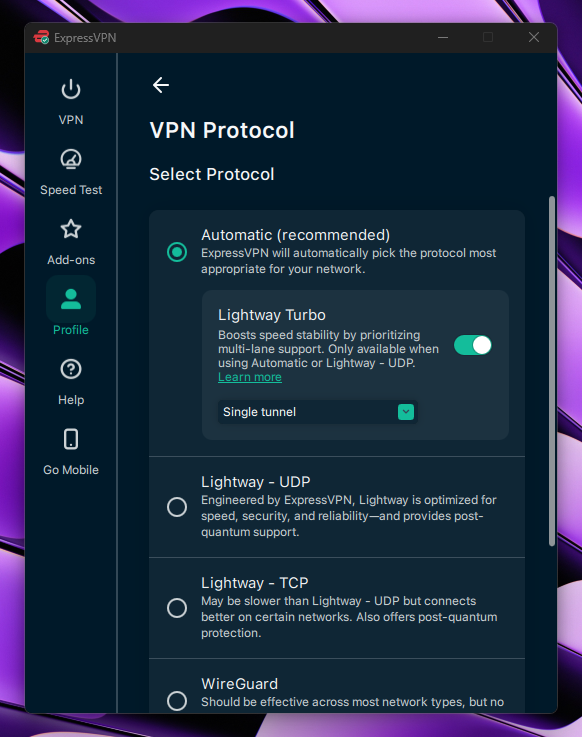
Post-quantum protection: Lightway includes post-quantum protection integrated with DTLS 1.3. ExpressVPN also added a post-quantum WireGuard implementation in 2025 using ML-KEM-based key exchange, giving users two modern protocol options with quantum-resistant protections.
Obfuscation: ExpressVPN’s obfuscation activates automatically when a restrictive network is detected. No manual configuration needed — you don’t have to switch to a specific “obfuscated servers” category like NordVPN requires. This automatic activation is one of the best implementations in the industry.
Leak testing — no leaks detected
- IP leak test: Only ExpressVPN server IP visible. Real IP not exposed.
- DNS leak test: Only ExpressVPN’s private DNS servers visible. No ISP DNS exposure.
- WebRTC leak test: No real IP address visible through WebRTC on any browser tested.
DNS and IP leak protection are built into ExpressVPN’s apps by default — no manual configuration needed.
Kill switch — Network Lock
ExpressVPN calls its kill switch “Network Lock.” It blocks all internet traffic if the VPN connection drops — preventing any unencrypted data from leaking. I tested this by forcing server disconnections while connected; Network Lock blocked all traffic every time with no exposure window.
In my month of daily testing, Network Lock activated twice unprompted — once when a server timed out and once when I switched networks on mobile. Both times it worked exactly as intended.
Speed Test Results
ExpressVPN’s Lightway protocol delivers consistently fast speeds — solid but not class-leading in my testing. The network now spans 214 app-selectable locations in 113 countries, with a mix of 10Gbps and upgraded 40Gbps servers. NordVPN’s NordLynx and Surfshark’s WireGuard implementation were still faster on my high-baseline connection.
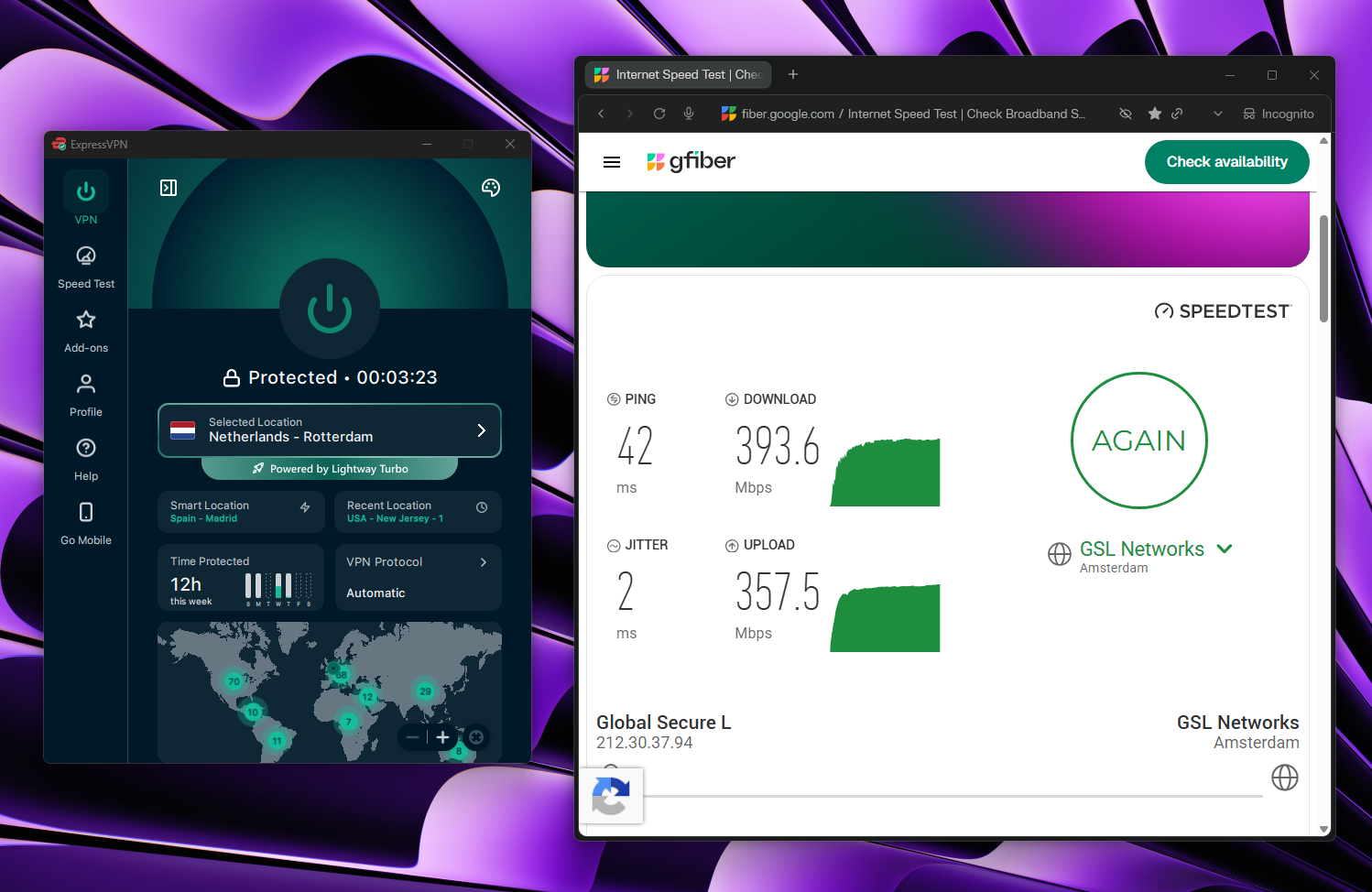
Speed test results — Lightway protocol (baseline: 930 Mbps from Europe)
| Server location | Download retention | Upload retention | Ping (ms) |
|---|---|---|---|
| UK (London) | 88% | 92% | 62 |
| US (East) | 71% | 17% | 326 |
| Japan (Tokyo) | 55% | 2% | 474 |
| Australia (Sydney) | 52% | 17% | 515 |
Nearby European servers retain 87–92% of baseline speed — imperceptible in daily use. Long-distance servers (US, Japan, Australia) show more pronounced drops, particularly on upload speed, which falls dramatically at distance. For everyday browsing and HD streaming on a reasonable connection, this isn’t noticeable. For users on gigabit connections who specifically need to preserve as much speed as possible, NordVPN is the faster pick.
Lightway’s NAT heartbeat feature is a small but practical advantage: it sends small packets to keep the VPN tunnel active during device idle. On other VPNs, a phone sitting idle can cause the VPN to sleep, delaying messages and emails. Lightway keeps the tunnel alive without affecting battery noticeably.
Streaming with ExpressVPN
ExpressVPN is one of the strongest streaming VPNs I’ve tested. In my testing, it unblocked virtually every major platform without needing to switch servers or clear cookies.
| Platform | Works? | Notes |
|---|---|---|
| Netflix US | ✅ Yes | Reliable, HD/4K quality |
| Netflix UK, JP, AU, CA, BR, ES | ✅ Yes | Multiple libraries tested, all working |
| Netflix FR, DE | ⚠️ Inconsistent | Blocked in some tests — likely Netflix EU content policy, not VPN issue |
| BBC iPlayer | ✅ Yes | Opened immediately, HD streaming, no buffering |
| Disney+ | ✅ Yes | US and international libraries |
| Hotstar | ✅ Yes | Unlocked immediately |
| ESPN+ | ✅ Yes | Sports blackout bypass working |
| DAZN | ✅ Yes | Working in testing |
| Amazon Prime Video | ✅ Yes | US and regional libraries |
| Hulu | ✅ Yes | US servers |
| GloboTV (Brazil) | ✅ Yes | Working via Brazilian servers |
| Paramount+ | ✅ Yes | Working |
| Crunchyroll | ✅ Yes | Working |
What makes ExpressVPN consistently better at streaming: The main app window is deliberately simple — no specialty server categories to wade through. You pick a country, connect, and the VPN’s detection-bypass systems handle the rest automatically. Obfuscation activates without user intervention when needed. For non-technical users who just want something that works, this is the smoothest streaming VPN experience available.
US state-level coverage: ExpressVPN has servers in all 50 US states — useful for bypassing regional sports blackouts (NBA League Pass, NHL.TV, regional blackouts on ESPN+ and DAZN). Very few VPNs match this level of US granularity.
MediaStreamer (Smart DNS): ExpressVPN includes a Smart DNS service called MediaStreamer for devices that can’t install VPN apps (some smart TVs, gaming consoles). This lets you unblock US streaming on PlayStation, Xbox, Roku, or older smart TVs by adjusting DNS settings only — no full VPN encryption, but useful for streaming-only needs on those devices.
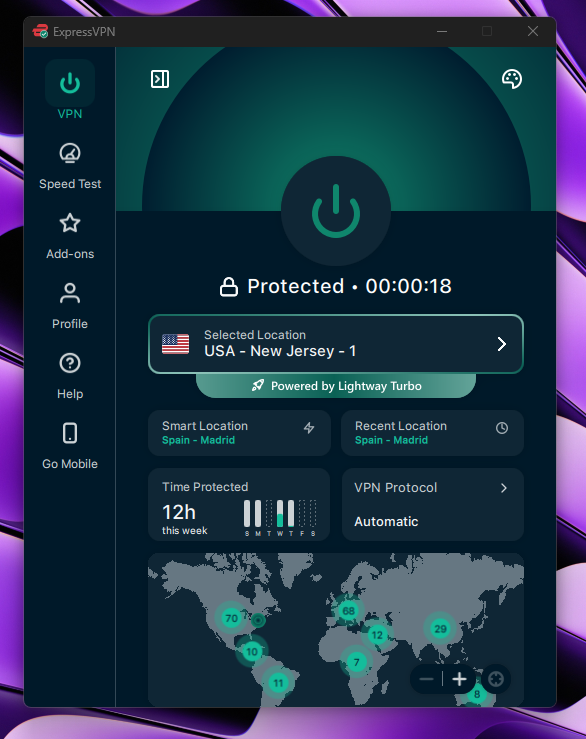
Torrenting with ExpressVPN
ExpressVPN supports P2P on all servers — no dedicated P2P server category to find, just connect and torrent. In my testing downloading a 5.31GB Ubuntu 25 ISO file using Lightway on Windows:
- Download completed in 2 minutes 13 seconds
- Average speed: 39 Mbps
- Peak speed: 51 Mbps
For context: NordVPN and Proton VPN downloaded the same file in 57 seconds. Surfshark took just over 1 minute. ExpressVPN’s torrenting speeds are decent but trail behind the fastest options.
No dedicated P2P servers, no port forwarding, no SOCKS5 proxy. These features improve torrent speeds and seeding ratios — particularly port forwarding for private tracker users. If torrenting performance is your primary VPN use case, NordVPN, Proton VPN, or PIA are stronger picks.
Features — What ExpressVPN Actually Includes
Lightway protocol — built for mobile
Lightway was designed by ExpressVPN for fast, resilient VPN connections, especially on devices that move between networks. Its lightweight architecture aims to reduce connection overhead, and the protocol was reimplemented in Rust in 2025 with its core code remaining open source. In my testing it connected quickly and stayed stable when moving between networks. ExpressVPN also continues to use NAT heartbeats to help maintain an idle tunnel without waiting for a full reconnect.
Post-quantum WireGuard — added in 2025
ExpressVPN now offers its own enhanced WireGuard implementation alongside Lightway. It adds post-quantum ML-KEM key exchange, ephemeral credentials, dynamic internal IPs, short-lived authentication tokens, and TrustedServer integration. WireGuard is available across major ExpressVPN apps, while Lightway remains the default protocol.
Automatic obfuscation
ExpressVPN’s obfuscation auto-activates when a restrictive network is detected — no manual server switching or protocol changes needed. This is the best obfuscation implementation I’ve tested. NordVPN requires you to switch to OpenVPN protocol and find obfuscated servers manually. Proton VPN requires selecting the Stealth protocol. ExpressVPN handles it invisibly. This is the primary reason ExpressVPN is the most reliable VPN for China, UAE, Russia, and heavily restricted networks.
Aircove router — unique in the industry
ExpressVPN’s Aircove is a Wi-Fi 6 router with ExpressVPN built in. Unlike a basic manual VPN router setup, Aircove lets you:
- Assign up to five different VPN server locations across different device groups simultaneously
- Route specific devices completely outside the VPN
- Manage VPN routing from the router dashboard without installing a separate VPN app on every device
At the time of writing, ExpressVPN’s store lists the standard Aircove bundle at $189.90 with a 6-month ExpressVPN subscription and Aircove Go at $169.90. Aircove Go is USB-C powered and designed for travel or smaller spaces. An active ExpressVPN subscription is required for VPN functionality after any included trial or subscription period.
ExpressVPN still provides its dedicated router firmware for selected Asus, Linksys, and Netgear models. Other compatible routers can use manual OpenVPN configuration. The March 31, 2026 deadline applied to legacy ExpressVPN app versions reaching end of life — it was not a blanket discontinuation of ExpressVPN’s third-party router app.
Split tunneling
ExpressVPN now supports split tunneling across Windows, macOS, Linux, Android, and iOS, although the controls vary by platform. Windows, macOS, and Linux can route selected apps and supported IP/subnet traffic through or outside the VPN. Android supports app-based split tunneling. On iOS 15 and later, ExpressVPN offers a more limited implementation that lets you exclude specific websites via IP-address rules while keeping the rest of your traffic protected.
ExpressKeys password manager
Included with Advanced and Pro plans. Stores passwords in an encrypted vault, generates strong passwords, and auto-fills credentials. A useful bonus if you’d otherwise pay for a standalone password manager. Basic plan users don’t get this.
Apps and Usability — Platform by Platform
The honest summary on apps: ExpressVPN sets the standard for VPN app design. Every platform feels consistent, clean, and immediately understandable — even for someone who’s never used a VPN. If you’re recommending a VPN to a non-technical parent or partner who will call you for help setting it up, ExpressVPN is the right recommendation for simplicity alone.
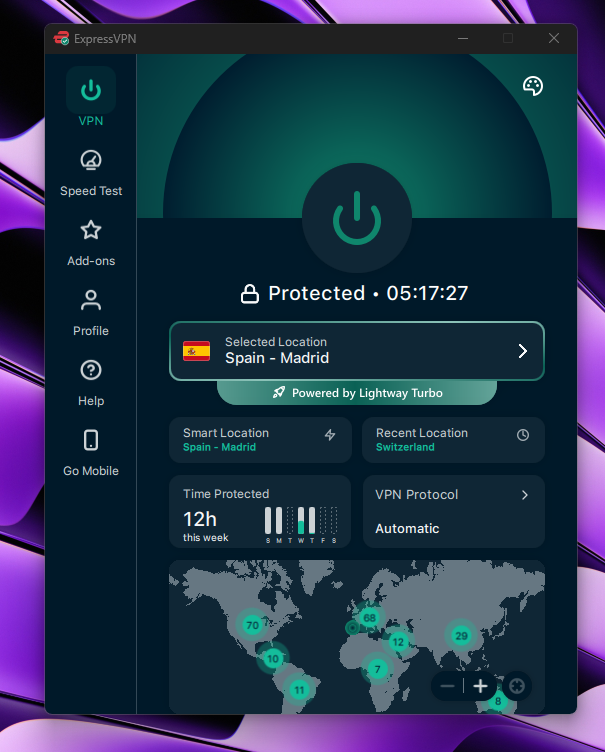
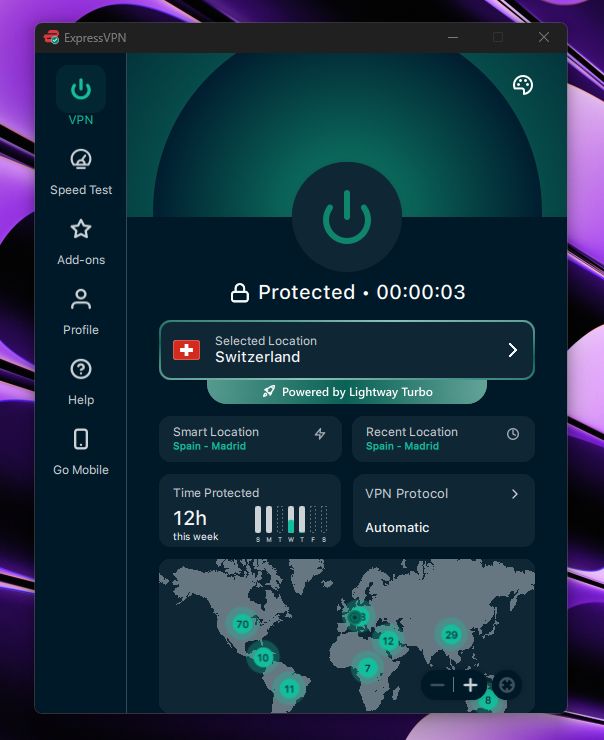
Windows: Clean interface with location selection front and center. Advanced settings open in a separate panel — keeps the main screen uncluttered. All features available. Smart Location automatically connects you to the best server for your current network.
macOS: The redesigned macOS app supports macOS 11 and later and now includes split tunneling again, along with WireGuard, dedicated IP support, network automation, command-line control, favorites, dark mode, and an advanced kill-switch option. The overall interface remains consistent with the Windows app.
iOS: Mirrors the desktop app closely and now includes a limited form of split tunneling for website exclusions on iOS 15 and later. WireGuard and Lightway are both available. A 3-day free trial is available when subscribing through the App Store.
Android: Full feature parity including split tunneling. 3-day free trial via Google Play. Lightway’s NAT heartbeat keeps background connectivity stable — no delayed notifications while VPN is active.
Linux: GUI app available — genuinely rare for VPNs. Most competitors offer command-line only. ExpressVPN’s Linux GUI is another example of their polish advantage.
Smart TVs and streaming devices: Native apps for Amazon Fire TV, Apple TV, Android TV, Google TV, and Chromecast. Clean interfaces designed for remote navigation.
Gaming consoles: Works via MediaStreamer (Smart DNS) on PlayStation, Xbox, Nintendo Switch, and Roku — no native app required on console, just DNS settings adjustment.
Customer Support
| Support channel | Available |
|---|---|
| 24/7 live chat | ✅ |
| Email support | ✅ (slow — up to 48 hours) |
| Phone support | ❌ |
| Knowledge base and guides | ✅ |
Live chat connects you to an AI assistant first, then a human agent — the AI resolved basic queries, human handoff took approximately 3 minutes in my testing. Human agents were knowledgeable, responding within a minute each time. Email support is slow — up to 48 hours, which is the weakest point in ExpressVPN’s support stack. If phone support matters to you, IPVanish is the only VPN on this list that offers it.
ExpressVPN vs. The Main Competitors
| ExpressVPN | NordVPN | Surfshark | Proton VPN | |
|---|---|---|---|---|
| Current long-term intro price | $2.99/mo (Basic) | $3.49/mo (Basic) | $2.49/mo (Starter) | From about $2.99/mo; offers can vary |
| Speed in my testing | Fast | 🏆 Fastest | Fast | Fast |
| Devices | 10 Basic / 12 Advanced / 14 Pro | 10 | Unlimited | 10 |
| Countries | 113 | 167+ | 100 | 140+ |
| Jurisdiction | BVI | Panama | Netherlands | Switzerland |
| Kape-owned? | ✅ Yes | ❌ No | ❌ No | ❌ No |
| Censorship / obfuscation tools | Automatic obfuscation with Lightway | Obfuscated servers / NordWhisper | NoBorders / Camouflage | Stealth protocol |
| Independent audits | Multiple — KPMG, PwC, Cure53, Praetorian and others | Multiple independent audits | Multiple independent audits | Regular no-logs audits + open-source apps |
| Port forwarding | ❌ | ❌ | ❌ | ✅ |
ExpressVPN vs NordVPN: ExpressVPN Basic is currently cheaper than NordVPN Basic on their standard long-term introductory offers ($2.99/mo vs $3.49/mo), although both promotions can change. In my testing NordVPN remains faster, and its network now covers more countries. ExpressVPN’s strongest differentiators are its simpler apps, automatic obfuscation, all-50-state U.S. coverage, and tightly integrated router ecosystem. Full NordVPN page →
ExpressVPN vs Surfshark: Surfshark’s current Starter offer is about $0.50/mo cheaper and includes unlimited device connections. ExpressVPN is more polished in my experience and remains especially strong for restrictive networks and router users. For pure value, Surfshark has the edge; for simplicity and automatic censorship resistance, ExpressVPN remains compelling. Full Surfshark page →
Who Should Buy ExpressVPN
- Non-technical users who want the simplest VPN experience — nothing is easier to use across all devices
- Users in or traveling to China, UAE, Russia, or other restrictive countries — automatic obfuscation is the best implementation in the industry
- Streaming users who want it to “just work” — simple server selection, automatic obfuscation when needed, and server coverage across all 50 US states
- Users who want broad location choice — 113 countries and 214 app-selectable locations, including all 50 US states
- Aircove router users — if you want a pre-configured VPN router with per-device location control, nothing else matches Aircove
- macOS and iOS users who prioritize simplicity — the most consistent cross-platform app experience available
Who Should Look Elsewhere
- Users specifically avoiding Kape Technologies — NordVPN, Surfshark, or Proton VPN are independent of Kape
- Budget-focused users — Surfshark Starter at $2.49/mo is currently about $0.50/mo cheaper than ExpressVPN Basic
- Speed maximizers — NordVPN’s NordLynx is measurably faster
- Heavy torrenters — NordVPN offers dedicated P2P servers, while Proton VPN and PIA are stronger choices if port forwarding matters
- Households with many devices — 10 devices on Basic; higher tiers allow 12 or 14; Surfshark, IPVanish, or PIA offer unlimited
- Users who need the most advanced multi-hop or port-forwarding controls — ExpressVPN still lacks double VPN and port forwarding; Proton VPN is stronger for those use cases
- Privacy maximalists — Proton VPN (Swiss, open-source, annual audits) is the stronger privacy pick
Frequently Asked Questions
Is ExpressVPN trustworthy given the Kape Technologies ownership?
ExpressVPN has been part of Kape Technologies since 2021. Kape also owns CyberGhost, Private Internet Access, and Webselenese, the company behind review properties including vpnMentor and Wizcase. ExpressVPN itself remains operated by Express Technologies Ltd. under British Virgin Islands jurisdiction, and its privacy policy states that ExpressVPN user data is controlled by ExpressVPN rather than its ultimate holding company. The service continues to publish independent security and privacy assessments, including a KPMG assessment published in 2025. The legitimate concern is corporate concentration rather than evidence that ExpressVPN’s VPN infrastructure suddenly stopped following its stated privacy model.
Does ExpressVPN work in China?
ExpressVPN remains designed for restrictive networks and Lightway can automatically apply obfuscation without requiring a separate obfuscated-server list. Reliability in China can change quickly as the Great Firewall is updated, so no VPN can guarantee 100% uptime. Based on my testing and the user reports I monitor, ExpressVPN remains one of the easier options to use in heavily restricted environments.
Does ExpressVPN work with Netflix?
Yes in my testing — reliably across US, UK, Japan, Australia, Canada, Brazil, and most other major Netflix libraries I tested. France and Germany were occasionally inconsistent. BBC iPlayer, Disney+, Amazon Prime Video, Hulu, ESPN+, Hotstar, DAZN, and other major platforms also worked in my tests, although streaming access can change at any time as platforms update their VPN blocking.
What is the Lightway protocol and why does it matter?
Lightway is ExpressVPN’s own VPN protocol with an open-source core. ExpressVPN reimplemented it in Rust in 2025, and the Rust code underwent independent assessments by Cure53 and Praetorian. It is designed for fast connection setup, reliable switching between networks, and low overhead on mobile devices. Lightway also includes post-quantum protection. ExpressVPN now supports a privacy-enhanced, post-quantum implementation of WireGuard as an alternative, but Lightway remains the default protocol.
How many devices can I use with ExpressVPN?
Basic supports 10 simultaneous VPN connections, Advanced supports 12, and Express Pro supports 14. If you need unlimited simultaneous connections, Surfshark, IPVanish, and PIA are alternatives to consider.
Is ExpressVPN good for torrenting?
Adequate for casual torrenting in my testing — the kill switch worked reliably and ExpressVPN’s privacy model is independently assessed. Speed is the main limitation in my test data: 39 Mbps average versus faster results from NordVPN and Surfshark on the same setup. ExpressVPN also lacks port forwarding and does not provide a dedicated P2P server category. If torrenting is your main use case, Proton VPN or another service with port forwarding may be a better fit.
Is ExpressVPN worth more than Surfshark?
It depends on what you value. Surfshark Starter is currently cheaper at $2.49/mo on its long-term introductory offer and allows unlimited devices. ExpressVPN Basic is $2.99/mo and earns its premium through especially polished apps, automatic obfuscation, 214 locations across 113 countries, all-50-state U.S. coverage, and the Aircove/router ecosystem. If those strengths do not matter to you, Surfshark remains the stronger budget pick.
Does ExpressVPN still support third-party routers?
Yes. ExpressVPN still provides dedicated router firmware for selected Asus, Linksys, and Netgear models, and manual OpenVPN setup is available for additional router platforms. The March 31, 2026 end-of-life announcement applied to legacy ExpressVPN app versions, not to all non-Aircove router support. Aircove and Aircove Go remain the easiest plug-and-play options in ExpressVPN’s router ecosystem.
Does ExpressVPN support split tunneling on Mac and iPhone?
Yes. Split tunneling returned to the redesigned macOS app for macOS 11 and later, while iOS 15+ now supports a more limited website-based implementation using IP exclusions. Windows, Linux, and Android also support split tunneling, with the exact routing controls varying by platform.
Final Verdict — Should You Buy ExpressVPN in 2026?
Yes — especially if simplicity, restrictive-network reliability, or router support matter to you. Surfshark remains the better pure-value pick for many households.
ExpressVPN’s 2026 offering is stronger than it was a year ago. The network has expanded to 113 countries and 214 app-selectable locations, including all 50 US states. Lightway was reimplemented in Rust in 2025, ExpressVPN added post-quantum WireGuard, split tunneling returned to modern macOS and arrived on iOS in a limited form, and the company now sells three subscription tiers instead of forcing every user into one bundle.
The privacy foundation remains a major strength: British Virgin Islands jurisdiction, TrustedServer RAM-only infrastructure, a no-activity/no-connection-logs policy, and repeated independent assessments including KPMG’s 2025 review of TrustedServer and privacy-policy claims. The Kape Technologies ownership is still relevant context for buyers who want to avoid concentrated ownership in the VPN industry.
Where ExpressVPN still falls short: no double VPN, no port forwarding, no unlimited device tier, and long-distance speeds in my testing trail the fastest competitors. Its renewal prices are also substantially higher than its introductory deals.
If ease of use is your #1 priority — or if you frequently use restrictive networks and want obfuscation to happen automatically — ExpressVPN is an easy service to recommend. If your main goal is the lowest long-term price and unlimited simultaneous devices, Surfshark remains my value pick.
80% OFF
ExpressVPN 2-Year Basic Plan
The easiest-to-use tier for most buyers — 113 countries / 214 locations, Lightway, TrustedServer RAM-only infrastructure, automatic obfuscation, and 10 simultaneous VPN connections.
Auto-obfuscation
Lightway + WireGuard
BVI HQ
Read next:
- ExpressVPN Coupon — current deal and pricing
- Surfshark Coupon (my #1 recommended VPN)
- NordVPN Coupon (fastest VPN)
- Best VPN for China in 2026 (ExpressVPN ranked top)
- All current VPN deals
The Review
ExpressVPN
One of the most polished, beginner-friendly VPN on the market. Lightway protocol delivers fast speeds, BVI jurisdiction provides strong privacy, and TrustedServer RAM-only infrastructure backs the no-logs policy. Where it falls short: no double VPN, no port forwarding, and owned by Kape Technologies — the same corporate group as CyberGhost and PIA.
PROS
- Very easy to use for beginners.
- Apps are polished on all major platforms.
- Works very reliably in restrictive countries.
- Works very reliably in restrictive countries.
- RAM‑only servers improve data security.
- RAM‑only servers improve data security.
- Unblocks many streaming services consistently.
- Lightway protocol gives stable mobile connections.
- 24/7 live chat support is available.
CONS
- More expensive than many competitors.
- Fewer advanced features (no double VPN, no port forwarding).
- Owned by Kape, which some users distrust.
- Torrenting works but is slower than top rivals.
- Split tunneling missing on iOS and newer macOS.
- Long‑term plans renew at much higher standard prices.
Review Breakdown
-
Value for Money
-
Speed
-
Privacy & Logging Policy
-
Streaming Performance
-
Ease of Use
ExpressVPN DEALS
We collect information from many stores for best price available
 expressvpn.com








Comments 1